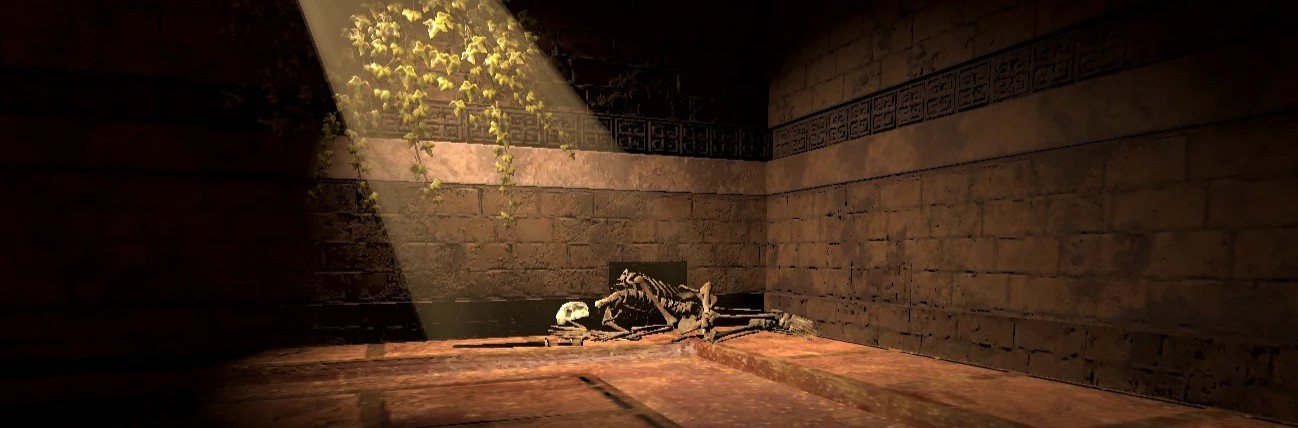
I was lead game and level designer on Xibalba, a mythological horror adventure game that won Best Student Game at Spilprisen 2025, the national awards show of the Danish game industry.
My responsibilites included:
- Providing design leadership for the team.
- Conceptualizing and designing all levels.
- Designing all puzzles and iterating on them based on controlled playtests.
- Creating early blockouts for evaluating level metrics and puzzle readability.
- Creating dozens of 3D assets that fit the game’s artstyle.
- Constantly adjusting priorities in collaboration with the producer to maintain scope.
- Reworking the game’s interaction system to streamline player experience.
Role
Lead Designer | Level Designer | 3D Artist
Team Size
6
Engine
Unity
Project Duration
7 weeks
Play
Designing a dungeon: Balancing tension with puzzle-solving
I designed Xibalba as a dungeon, focusing on exploration, puzzles and hidden dangers. The level layout alternates between tight, claustrophobic and open, one-scan rooms. This allowed me to create contrast and emphasize the intented player experience when placing different rooms and corridors next to each other.
I also used the contrast between symmetrical and asymmetrical areas to help players navigate the tunnels and make spaces more readable.

Final level

Level layout

Greybox level
Level Design Highlight:
Hub-and-spokes Design
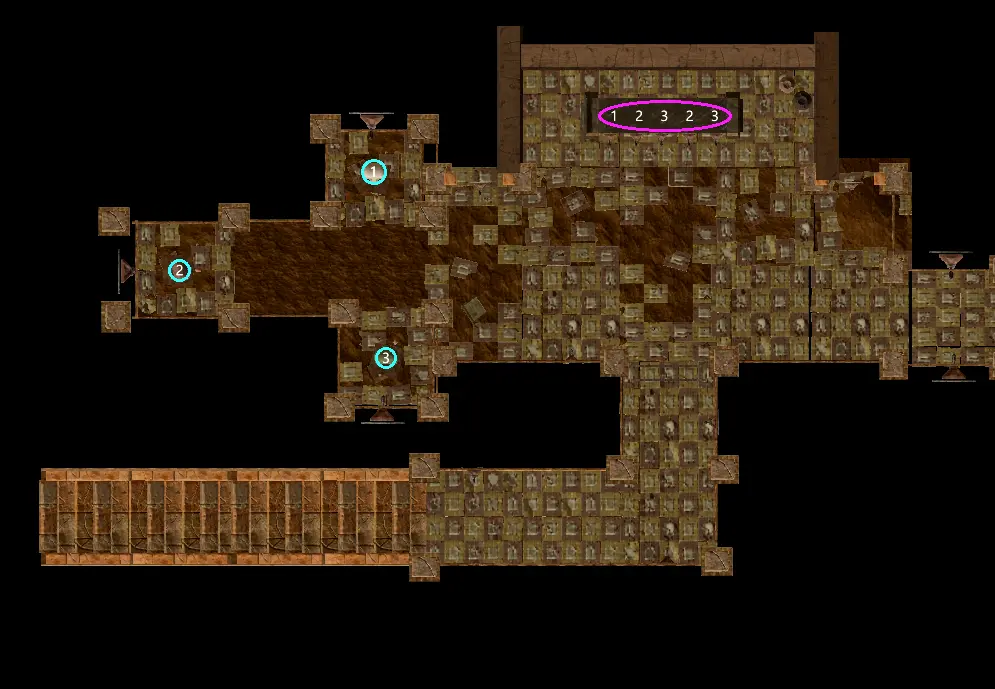
The second level features a central hub that serves as both a safe space and an orientational point.
After moving through dark, narrow corridors, arriving at the open central room provides a moment of relief. A healing statue is placed at its center that also serves as a landmark.
Multiple paths branch out from the hub, initially blocked by gates that require the player to solve puzzles or deal with enemies in a specific order. Each route eventually leads back to the central room. The statue’s green light is distinct from the game’s color palette, making it immediately recognizable from every entrance as the player returns to the hub.
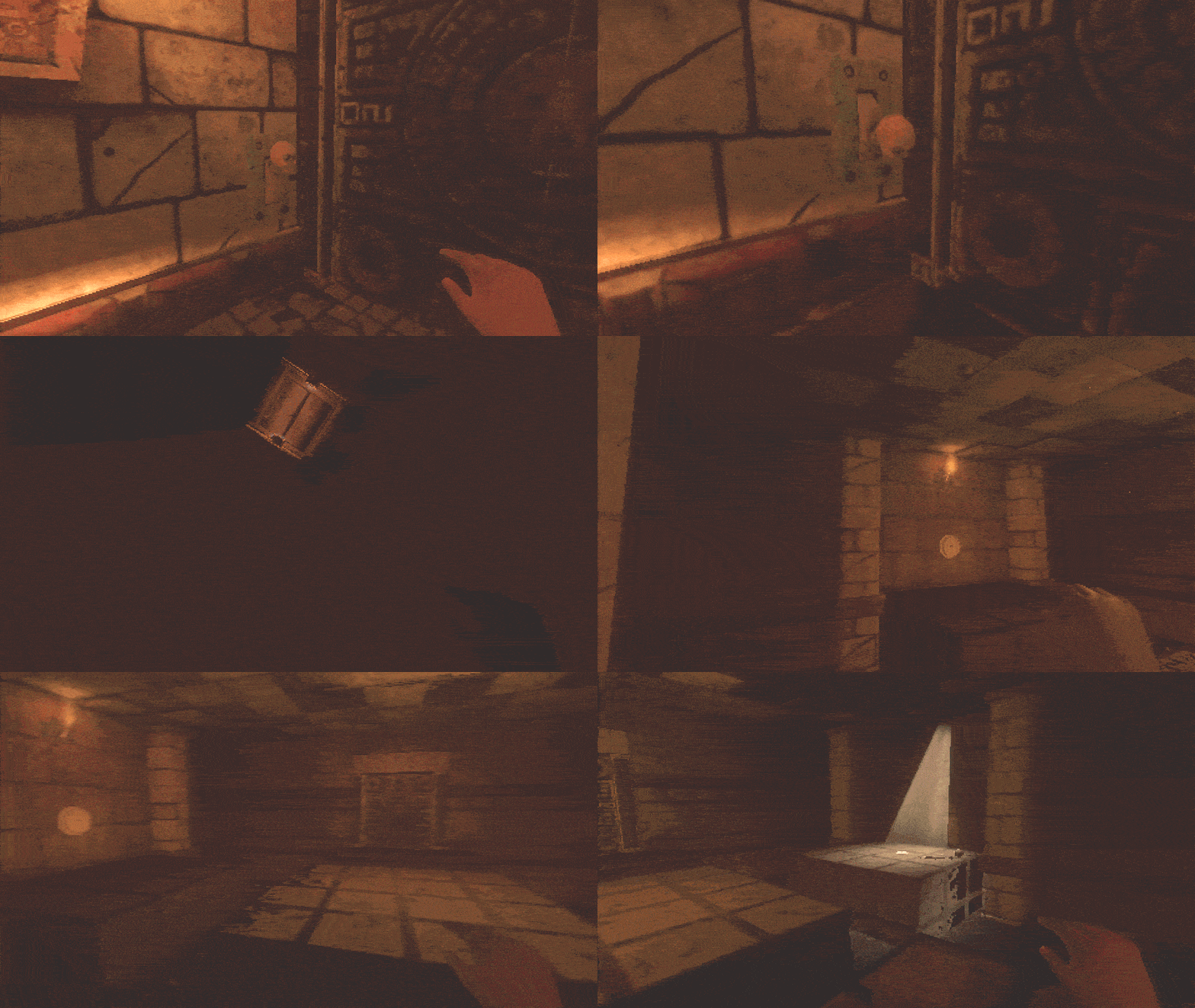
The player scans the room naturally on their own after falling down.
Guiding Attention: Communicating the objective intuitively
I wanted players to discover important information in a logical visual sequence so they intuitively knew what to do.
Early in the game, a lever beside a door appears to be the obvious way forward. When the player pulls it, the floor collapses, teaching them to be cautious around potential traps. The fall also controls the player’s initial viewpoint. After landing, players naturally look to the left, where I placed the keyhole for their next objective. As they continue scanning the room, they discover the closed door in front and finally the key on the opposite side, highlighted by a beam of light.
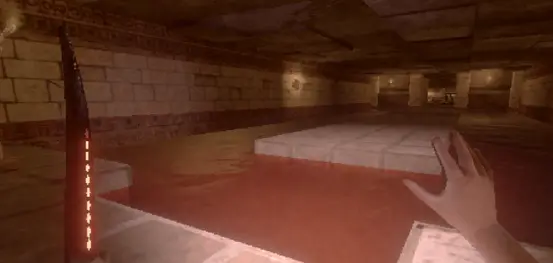
The obsidian dagger from the original version of the game.
Playtesting & Iterations: Redesigning the main interaction
Xibalba originally used an obsidian dagger for combat. As development shifted from survival combat to a more puzzle-focused horror experience, the dagger increasingly conflicted with the intended player behavior. Playtests revealed that players often tried to fight enemies instead of avoiding or outsmarting them.
The dagger was also designed for other purposes:
- To diegetically display player health,
- And as a tool players could use to draw their character’s blood to perform puzzle-related actions.
To solve the issue, I replaced the dagger with an ancient disc inspired by Mayan circular calendars. Unlike the dagger, this new object didn’t create false combat-related affordances, while it also kept all other properties of the weapon.
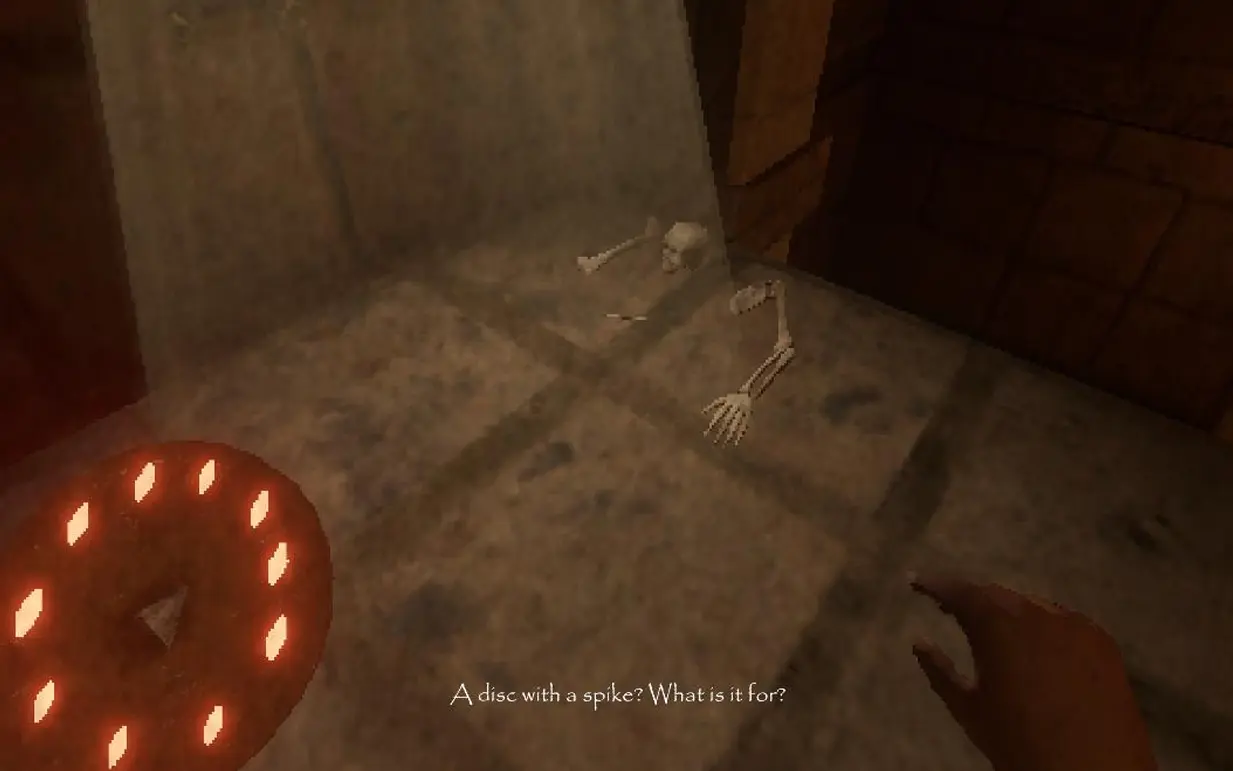
The Mayan disc that replaced the dagger.
Iterative puzzle design
One of the first puzzles of the game requires the player to use their newly acquired Light Power to reveal hidden symbols on objects.
My original concept was to foreshadow the puzzle and create a small jumpscare with the frightening statuettes. However, because players didn’t see the closed door first, and the statues appeared to belong to the previous room, some of them assumed they missed something and backtracked all the way to the beginning of the level.
The reworked version solves this issue by presenting the door and its puzzle first, then a connected side room contains all the interactable elements. This structure works much better as players understand the objective immediately, and when they solve the puzzle they can clearly see and hear the door opening, making it obvious which way to go.

The initial puzzle design and the reworked final version in the game.


